“Formally daring and politically incisive, Mermaid Theory reckons with water as history, as present, as divinity, as desire, as fear. This is a poet who sings from the river to the sea. Maya Salameh is a poet who knows that to write is to "sing until the empire is over.”
“From Syria to the house party, there is no landscape Maya Salameh cannot paint with rigorous spirit, delectable lyric, and a fierce poetics all her own. Mermaid Theory breathes the wonder of myth into the poet’s witnessing.... a book that demands to be read aloud with friends, a book that feels a warm room where your best girls are waiting for you to arrive.”
“A delight of dream-logic, old and new mythologies, intimacies, hallucinatory sciences. I will read anything Maya Salameh writes. Mermaid Theory is awash with newnesses, with wonder.”
“How do we stare back at appliances of the surveillance state? How do we begin to say, the computer is not infallible, the algorithm is riddled with bugs we can pick at and opinions that can be rewritten. One important space of freedom for me was interacting with technological forms in more rambunctious ways, imposing play on the algorithm.”
“By defiling the clinical nature of the algorithm, bringing it into the visceral, gory reality of our bodies, we render it also a body that we can challenge and question.”
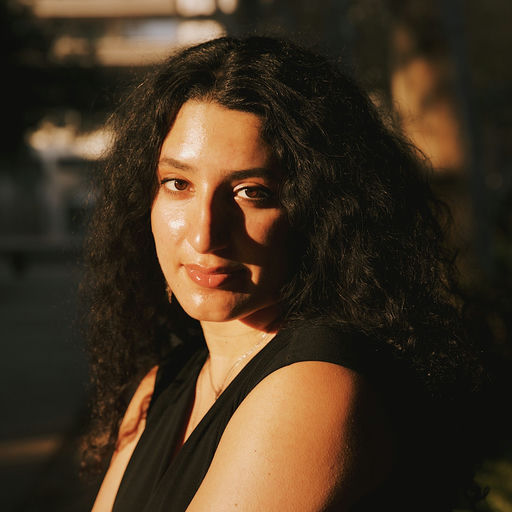
Maya Salameh is a Syrian- and Lebanese-American writer from San Diego, California. She is the author of Mermaid Theory (Haymarket Books, 2026) and How to Make an Algorithm in the Microwave (University of Arkansas Press, 2022), winner of the Etel Adnan Poetry Prize and finalist for the California Book Award. Her poems have appeared in The Rumpus, Poetry, The Offing, LitHub, Gulf Coast, AGNI, ANMLY, and the LA Times, among others. A 2025 National Endowment for the Arts Fellow, Maya has received the Sewanee Review Poetry Prize, the Lambda Literary Award for Exceptional New Writers, and support from the Tin House Writers' Workshop, Kenyon Review Writers' Workshop, and Sewanee Writers' Conference. From 2016–2017, she served as a National Student Poet, America's highest honor for youth poets. She has taught poetry workshops for Brooklyn Poets, Ellipsis Writing, and Workshops4Gaza, with a focus on experimental forms and ecopoetics. She is currently a law student at UCLA, where she aims to be a civil rights litigator.
Maya Salameh is the author of MERMAID THEORY (Haymarket Books, 2026), HOW TO MAKE AN ALGORITHM IN THE MICROWAVE (University of Arkansas Press, 2022), winner of the Etel Adnan Poetry Prize, and the chapbook rooh (Paper Nautilus Press, 2020). She has received fellowships from the National Endowment for the Arts, Sewanee Writers’ Conference, Bread Loaf Environmental Writers’ Conference, and the President’s Committee for the Arts and Humanities, and served as a National Student Poet, America’s highest honor for youth poets. Her work has appeared in The Offing, Poetry, Gulf Coast, The Rumpus, AGNI, Mizna, and the LA Times, among others.
- Students, educators
- Cultural workers
- Community members invested in anti-colonial, feminist, and abolitionist frameworks
- University cultural centers
- Ethnic studies and creative writing departments
- MFA programs
- Human rights and abolitionist orgs
- Grassroots collectives that center MENA, SWANA, and queer communities
- Events used for mutual aid fundraising for Palestine
- Intersection of the lyric and the political
- Arab girlhood
- Surveillance, technology, empire
- Queerness
- Grief
- Inherited memory
- Belief in body as both archive and oracle
- Performance to rupture the boundaries between documentation and ritual
- Slam poetry
- Artist talks
- Workshops
- Live poetry performances
- Keynote speeches
- Panel discussions
- Class visits
- Commissioned writing
Reading with Open Mouth Literary Center